The afternoon was unusually quiet.
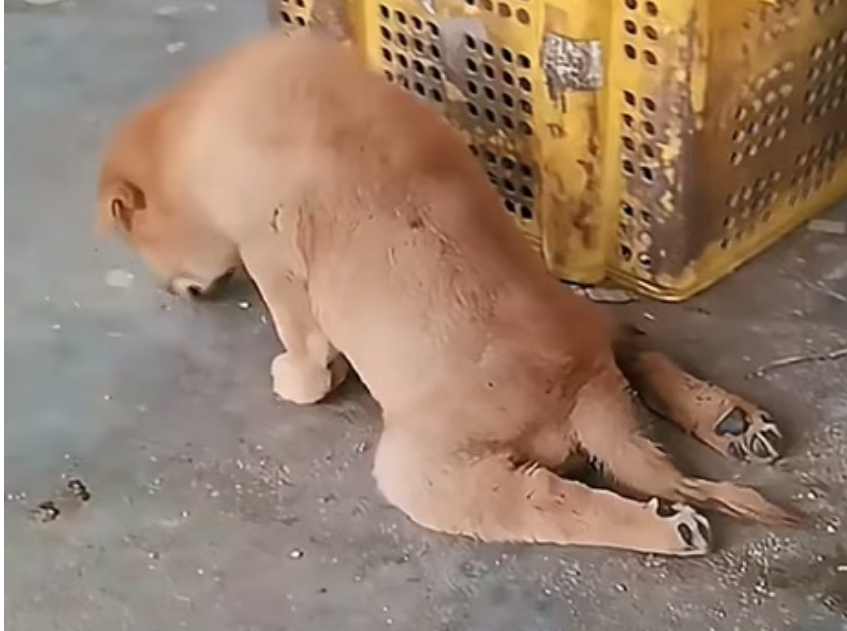
Under a cloudy sky, a small workshop porch sat almost empty. A parked car stood near the entrance, a pink sack rested against the wall, and beside a large yellow plastic crate lay a tiny light-brown puppy.
At first glance, it was easy to miss him.
He was very small.
His front paws supported most of his body while his hind legs stretched helplessly behind him.
They did not move.
His little chest rose and fell rapidly.
Then came the sound.
“Hhh… whimper…”
A strained, raspy cry.
It came again.
And again.
The puppy kept trying to lift his head, but fatigue pulled his chin back toward the dusty concrete.
He had no idea if anyone was coming.
He only knew that he couldn’t move.
A woman named Emma was walking past the workshop when she heard the strange sound.
She stopped.
At first, she thought it was a bird trapped somewhere nearby.
Then she heard it again.
“Hhh… hhh…”
Emma followed the sound toward the porch.
Behind the yellow plastic crate, she saw two dark eyes looking toward her.
The puppy was awake.
But he looked exhausted.
His front paws trembled as he tried to push himself forward.
His hind legs remained completely still.
Emma crouched down several feet away.
“Oh, sweetheart…”
The puppy looked at her.
His mouth opened slightly.
Another weak raspy whimper escaped.
Emma immediately called a local animal rescue team.
“There is a very small puppy here,” she explained.
“He can’t use his back legs, and he’s extremely weak.”
While waiting, Emma stayed beside him.
She didn’t try to pull him.
She didn’t want to hurt him.
Instead, she placed a clean cloth nearby and spoke quietly.
“You’re not alone.”
“I’ll stay with you.”
The puppy’s eyes remained fixed on her.
Every few seconds, he tried to lift his head.
His front paws shifted weakly against the concrete.
But he couldn’t move forward.
The rescue team arrived shortly afterward.
Two rescuers, Daniel and Sarah, approached carefully.
Daniel knelt down and examined the puppy from a safe distance.
Sarah looked at the little dog’s hind legs.
“He needs medical attention immediately.”
Daniel nodded.
“But let’s move him very carefully.”
The puppy began whimpering louder when he saw the strangers.
Sarah lowered herself to the ground.
“It’s okay.”
“We’re here to help.”
The puppy’s front paw moved slightly.
Sarah held out her hand.
He sniffed her fingers.
Then rested his chin on the ground again.
They prepared a soft blanket.
Daniel gently supported the puppy’s chest while Sarah carefully supported his lower body.
The moment they lifted him, his front paws moved instinctively.
He was trying to help them.
“Easy,” Sarah whispered.
“You don’t have to walk.”
“We’ll carry you.”
The puppy gave one quiet whimper.
Then relaxed into the blanket.
For the first time, he wasn’t lying directly on the cold concrete.
He was being held.
They named him Buddy.
At the veterinary clinic, the veterinarian examined him carefully.
Buddy was severely exhausted and dehydrated.
His hind legs had very limited movement, and the veterinarian suspected that he had suffered an injury that prevented him from using them normally.
But there was still hope.
“We need to stabilize him first,” the veterinarian said.
“Then we’ll determine what treatment and rehabilitation he needs.”
Sarah looked at Buddy.
His eyes were half closed.
But he was still breathing.
Still fighting.
Still here.
That first night was difficult.
Buddy barely moved.
He rested on a soft blanket while the veterinary team monitored him.
Every few hours, someone checked on him.
Whenever he woke, he looked around nervously.
Sarah was often there.
She would sit beside his bed.
“You made it through today.”
“That’s enough.”
Buddy couldn’t answer.
But sometimes he would move his front paw toward her hand.
That became their little routine.
The next morning, something unexpected happened.
Buddy tried to move.
His front legs pushed against the blanket.
His chest lifted.
For a moment, his body moved forward.
Only a few centimeters.
Then he stopped.
Sarah stared.
“Did you see that?”
The veterinarian smiled.
“Yes.”
Buddy had moved himself.
It wasn’t much.
But it was the beginning.
Every day, Buddy became a little stronger.
He began eating better.
His breathing became calmer.
His eyes became brighter.
And his raspy cries became softer.
The rescue team started physical rehabilitation under veterinary guidance.
They helped him strengthen his front legs and gently encouraged movement in his hindquarters.
At first, Buddy seemed confused.
He would look down at his legs.
Then look at the rescuers.
As if wondering why they wouldn’t move the way he wanted them to.
Sarah would smile.
“Don’t worry.”
“We’ll figure this out together.”
Weeks passed.
Buddy’s front legs became remarkably strong.
He learned how to pull himself across a soft rehabilitation mat.
One centimeter.
Then another.
Then another.
The first time he crossed the mat by himself, everyone in the room became silent.
Buddy reached the other side.
He stopped.
Looked back.
Then wagged his tail.
It was only a tiny movement.
But everyone saw it.
Daniel laughed.
“Buddy, you did it!”
From that day forward, Buddy seemed determined.
He would crawl toward anyone who entered the room.
He would chase small toys using his front paws.
He learned how to move himself around safely.
His hind legs were still weak, but he refused to let that stop him.
One afternoon, Sarah placed his favorite toy a short distance away.
Buddy stared at it.
Then pulled himself forward.
Slowly.
Carefully.
One paw at a time.
He reached the toy.
He placed his chin on it.
And looked up proudly.
Sarah laughed.
“You’re a little fighter, aren’t you?”
But Buddy still needed a permanent home.
The rescue center began searching for someone who understood that he might need lifelong care and patience.
Many people asked about him.
But some wanted a dog who could run.
Buddy couldn’t promise that.
Then one afternoon, a man named David came to visit.
He sat quietly beside Buddy.
He didn’t ask whether Buddy could run.
He asked:
“What does he need?”
Sarah smiled.
“Patience. Love. And someone willing to help him live his best life.”
David looked at Buddy.
“I can do that.”
Buddy went home with David.
The house was prepared for him.
There were soft mats across the floor.
His food and water were placed where he could easily reach them.
A comfortable bed was positioned near the window.
David even built a small ramp so Buddy could move between different areas of the house safely.
For the first few days, Buddy was cautious.
He didn’t know what this new place was.
But David never rushed him.
Every morning, he sat beside Buddy.
Every evening, he helped him settle into his bed.
Slowly, Buddy began to trust him.
One morning, David woke up and heard something.
Tap.
Then another.
Tap. Tap.
He walked into the living room.
Buddy was moving across the floor by himself.
His front paws pulled his body forward.
His little hind legs followed as best they could.
He had crossed almost the entire room.
David smiled.
“Buddy…”
The puppy looked up.
His tail began wagging.
David crouched down.
“You wanted to come see me?”
Buddy continued forward.
Then rested his head against David’s knee.
Months passed.
Buddy became part of the family.
He couldn’t run like other dogs.
But he had found his own way to move through the world.
He loved sitting beside the window.
He loved playing with soft toys.
He loved greeting David every morning.
And whenever someone came home, Buddy would pull himself toward the door as quickly as he could.
His life wasn’t perfect.
But it was full.
And it was safe.
One afternoon, Emma—the woman who had first found him—visited.
She had wondered many times what happened to that tiny puppy beneath the yellow crate.
When she saw Buddy, she almost didn’t recognize him.
His coat was clean.
His eyes were bright.
His body was stronger.
And the moment Buddy saw her, his tail began wagging.
Emma knelt down.
“Buddy?”
The puppy moved toward her.
She covered her mouth with her hand.
“It’s really you.”
Buddy reached her and gently placed his head against her lap.
Emma began to cry.
Not because she was sad.
Because she remembered the little puppy who couldn’t even lift his head.
And now he was coming to greet her.
Emma gently touched his fur.
“I remember you.”
“You were so tired.”
Buddy looked up at her.
His tail moved again.
David smiled.
“He still makes that little sound when he wants attention.”
Buddy gave a tiny raspy whimper.
Everyone laughed.
It was the same sound that had once broken Emma’s heart.
But now it meant something different.
Now it meant:
I’m here.
I’m safe.
I’m happy.
That evening, Buddy rested beside the window.
The sunlight disappeared behind the clouds.
The house became quiet.
David placed a blanket around him.
Buddy closed his eyes.
His breathing was slow and peaceful.
He no longer had to fight against the cold concrete.
He no longer had to struggle alone.
He no longer had to wonder whether someone would hear him.
Someone had heard.
Someone had stopped.
Someone had carried him to safety.
And someone had decided that his life was worth fighting for.
The yellow crate was still sitting at the old workshop.
The dusty concrete was still there.
The parked cars still came and went.
But the tiny puppy who once lay helpless beside that crate was no longer there.
He had been given another chance.
He had been given treatment.
He had been given a family.
Most importantly, he had been given time to discover that his life could still be beautiful.
Buddy couldn’t run toward the people he loved.
So he learned another way.
He crawled.
He pulled himself forward.
He waited.
And every time he reached them, his tail wagged with everything he had.
The little puppy who once couldn’t move his body was finally moving toward his future.
He had been rescued.
He had survived.
And he had found a home where nobody cared how fast he could run—only how much he wanted to live.
The 2026 Rolls-Royce Phantom Series II: A Strategic Guide to the Ultimate Real Estate on Wheels
In the world of ultra-high-net-worth asset acquisition, few names carry the weight of the Rolls-Royce Phantom Series II. As we move through 2026, the landscape of luxury has shifted. It is no longer just about the “best car in the world”—it is about the preservation of capital, the expression of bespoke identity, and the strategic acquisition of an asset that transcends typical automotive depreciation.
Having spent over a decade navigating the nuances of the luxury automotive and high-end investment markets, I have seen trends come and go. However, the Rolls-Royce Phantom Series II remains the undisputed benchmark. For the serious collector or the executive looking to solidify their presence, understanding the 2026 iterations—including the avant-garde Platino and the legacy-driven Metropolitan motifs—is essential for making an informed financial decision.
The Evolution of an Icon: What’s New for 2026?
The Rolls-Royce Phantom Series II is not a radical departure, but rather a surgical refinement. The marque understands that when you own the pinnacle, you do not reinvent it; you polish it.
Aesthetic Presence and Tech Integration
The most immediate change is the “Polished Horizon.” A new horizontal line between the daytime running lights gives the Phantom a more grounded, modern stance. The Pantheon Grille is now subtly illuminated—a feature borrowed from the Ghost but executed with more gravitas here.
For the tech-forward owner, the “Rolls-Royce Connected” suite has become a vital tool in 2026. It bridges the gap between your mobile office and the vehicle via the Whispers app. In my experience, the ability to send a destination from your smartphone directly to the car’s navigation before you’ve even finished your morning espresso is a small but significant luxury that saves the one thing my clients value most: time.
What This Means for You: The Financial Logic of the Phantom
When you are looking at a vehicle with a pricing entry point well north of $500,000, the conversation isn’t about “affordability”—it’s about cost vs. value.
Investing in a Rolls-Royce Phantom Series II in 2026 is akin to purchasing prime real estate in Mayfair or Manhattan. It is a defensive asset. While a standard luxury SUV might lose 40% of its value in three years, a Bespoke Phantom—especially one with unique commissions like the Platino or the Metropolitan Collection—tends to follow a much shallower depreciation curve, often finding a floor and holding it due to its scarcity.
Comparison: Standard Commission vs. Bespoke Masterpiece
| Feature | Standard Phantom | Bespoke (Platino/Metropolitan) |
|---|---|---|
| Market Rarity | High | Extreme (1 of 1 or Limited Run) |
| Interior Materials | Premium Leather | Bamboo Silk, Marquetry, Hand-stitching |
| Resale Trajectory | Predictable Depreciation | High Collector Demand |
| Initial Cost Impact | Base MSRP | +20-50% Premium |
Case Study: The “Art of the Commission”
Last year, I worked with a client—let’s call him James—who was torn between a standard Phantom and a highly Bespoke Series II featuring the new 3D milled stainless steel wheels and a darkened chrome exterior.
James opted for the Bespoke route, incorporating elements of the Metropolitan Collection’s wood marquetry. In early 2026, he received an unsolicited offer for the vehicle that was 12% higher than his original cost. Why? Because he didn’t just buy a car; he commissioned a piece of “automotive art” that bypassed the waiting list for new builds. This is the best financial strategy in the ultra-luxury segment: build what others cannot easily replicate.
Should You Buy, Wait, or Invest?
As an industry expert, my advice for 2026 is clear:
BUY NOW if you are looking for the definitive statement of success. The Rolls-Royce Phantom Series II is currently at its technological peak before the full industry pivot to electric drivetrains. This V12 engine is a masterpiece that will likely become a coveted relic.
WAIT only if you are holding out for the “Spectre” electric equivalent, but be warned: the gravitas of the V12 Phantom is irreplaceable in the current real estate investment mindset of car collectors.
REFINANCE / LEASE if you are using the vehicle for a corporation. Many of my clients utilize sophisticated home loans or asset-backed lines of credit to fund these acquisitions, keeping their liquid capital free for high-yield investments while enjoying the tax benefits of a corporate vehicle.
The Phantom Platino and Metropolitan: A Tale of Two Philosophies
The 2026 market has seen a surge in “sustainable luxury.” The Phantom Platino is the response to this. By replacing traditional leather on the rear seats with a combination of white silken textile and bamboo-derived fibers, Rolls-Royce has redefined what “expensive” feels like.
Conversely, the Metropolitan Collection—with its 500-piece wood veneer marquetry depicting cityscapes—appeals to the traditionalist. If you are comparing best options, the Platino is for the forward-thinking visionary, while the Metropolitan remains the gold standard for those who value old-world craftsmanship.
Cost Breakdown & Pricing Impact
The cost of a Phantom is never a fixed number. When considering your home loans or capital allocation, factor in:
Base MSRP: Roughly $490,000 – $550,000.
Bespoke Additions: Typically $100,000 – $250,000.
Maintenance: Covered under the four-year service plan, but post-warranty costs are significant.
Insurance: High-value premiums are a necessity; expect to work with specialized carriers.
Mistakes to Avoid That Could Cost You Money
In my 10 years in this industry, I’ve seen buyers make the same three mistakes:
Over-personalizing with “Loud” Colors: While the palette offers 44,000 shades, choosing a highly eccentric color can narrow your resale market significantly. If you want to protect your investment, stick to “Darkest Tungsten” or classic “English White” with a bold interior.
Skipping the “Extended” Wheelbase: For the Rolls-Royce Phantom Series II, the Extended version often commands a much higher premium on the secondary market. If you are being chauffeured, the extra rear legroom is a non-negotiable for future buyers.
Ignoring the “Connected” Features: Ensure your vehicle is fully integrated with the Whispers ecosystem. A “dark” car (one without active digital services) is less desirable in the 2026 used market.
Best Financial Strategies Right Now (2026)
If you are looking to maximize the ROI (Return on Influence and Investment) of your Rolls-Royce Phantom Series II, consider the following:
The “Collection” Strategy: Seek out limited runs like the Metropolitan. Scarcity drives the mortgage rates of the automotive world; the rarer the car, the better the loan-to-value ratio.
The Tax Play: In many jurisdictions, the Phantom’s weight and usage can offer specific depreciation benefits for business owners. Consult with your tax professional to see if a lease-to-own structure is more beneficial than a cash purchase.
The Aesthetic Hedge: Opt for the 1920s-style disc wheels. They are currently trending heavily in 2026 and are seen as a “must-have” for the Series II, much like a specific dial on a Rolex.
Final Expert Verdict
The Rolls-Royce Phantom Series II is not merely a mode of transport; it is a fortress. Whether it is the shimmering laser-cut starlight headlights or the bamboo fibers of the Platino, every inch of this vehicle is designed to signal that you have arrived. In a volatile 2026 economy, putting your money into a tangible, world-class asset is one of the safest bets a high-intent buyer can make.
Don’t settle for a standard luxury experience when you can command the pinnacle of automotive engineering and bespoke artistry.
Ready to elevate your collection and secure a masterpiece? [Compare Bespoke Options and Check Current Financing Rates for the Phantom Series II Today.]