The alley was quiet beneath the gray afternoon sky.
Tall buildings surrounded the narrow street, blocking most of the sunlight. A few old shops were closed for the day, and the only sounds were distant traffic, the hum of air conditioners, and the occasional rustle of plastic bags.
At the end of the alley stood a large metal dumpster.
It was overflowing with garbage.
Black plastic bags were piled over the edge.
Discarded food containers were scattered across the concrete.
Then something moved.
At first, it looked like another white plastic bag.
But the shape moved again.
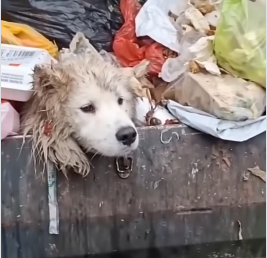
A small white head appeared between the garbage bags.
It was a dog.
Only its head was visible.
Its body was trapped deep inside the dumpster.
The dog’s white fur was wet and badly matted.
Its dark eyes looked exhausted.
It slowly turned its head from one side to the other.
It was searching.
For food.
For a way out.
Or perhaps for someone who would notice it.
A woman named Sarah was walking through the alley when she heard a faint sound.
A soft whimper.
She stopped.
The sound came again.
She followed it toward the dumpster.
When she saw the dog, she immediately froze.
“Oh my God…”
The dog looked at her.
Its ears moved slightly.
But it didn’t bark.
It simply stared.
Sarah stepped closer.
The dog tried to move.
The plastic bags shifted around its body.
But it couldn’t escape.
Sarah could see that the dumpster was deep.
The dog had probably fallen or been placed inside and become trapped beneath the garbage.
She immediately called a local animal rescue organization.
Then she stayed.
She didn’t want the dog to be alone anymore.
While waiting for the rescuers, Sarah stood beside the dumpster.
She spoke softly.
“It’s okay.”
“I see you.”
The dog blinked slowly.
A plastic bag moved beside its face.
The dog flinched.
Sarah gently moved it away.
The dog looked at her again.
Its eyes seemed to say something she couldn’t explain.
It was tired.
Very tired.
But it was still waiting.
The rescue team arrived about fifteen minutes later.
They immediately examined the dumpster.
The dog was trapped beneath several heavy garbage bags and food containers.
They needed to remove the trash carefully.
One wrong movement could cause the garbage to shift and hurt the animal.
The rescuers put on protective gloves.
They worked slowly.
One bag at a time.
They removed empty containers.
Then cardboard.
Then several heavy bags.
The dog watched them silently.
Every few minutes, it made a soft whimper.
One rescuer looked down.
“You’re doing great.”
“Just hold on.”
As more garbage was removed, the rescuers finally saw the dog’s front legs.
They were weak.
The dog tried to lift itself.
But it slipped.
The rescuer immediately supported its chest.
“Easy.”
“We’ve got you.”
The dog stopped struggling.
For the first time, it seemed to understand that these people were trying to help.
They continued clearing the dumpster.
Minutes passed.
The dog’s body slowly became visible.
Its fur was covered in dirt and food waste.
It was painfully thin.
But it was alive.
Finally, there was enough space.
Two rescuers reached down.
One supported the dog’s chest.
The other carefully supported its hindquarters.
They lifted.
The dog’s body came free from the garbage.
For a second, its legs hung in the air.
Then the rescuers brought it safely onto the pavement.
The dog stood for less than a second.
Its legs collapsed.
A rescuer caught it immediately.
The dog was exhausted.
But it was out.
Free.
They wrapped it in a clean blanket.
The dog trembled.
Its wet fur stuck to its body.
The rescuer gently covered its back.
“It’s okay now.”
“No more dumpster.”
The dog rested its head against the blanket.
Sarah stood nearby with tears in her eyes.
She had expected the dog to run away once it was free.
Instead, it simply remained beside the rescuer.
As if it finally understood that it didn’t need to fight anymore.
The dog was taken to a veterinary clinic.
The staff examined him immediately.
They discovered that he was severely dehydrated and underweight.
His fur was badly matted.
He had small scratches from being trapped among the garbage.
But there were no major injuries.
The veterinarian looked at the rescue team.
“He was very lucky.”
Another day in that condition could have been dangerous.
The rescuers named him Snow.
Because beneath all the dirt and tangled fur, his coat was completely white.
Snow spent his first night at the clinic sleeping.
He was given small amounts of water and food.
He couldn’t handle a large meal.
His body needed time to recover.
A volunteer sat beside him.
Every few hours, Snow opened his eyes.
Each time, someone was still there.
The volunteer gently touched his head.
“You’re safe.”
Snow slowly closed his eyes again.
The next morning, Snow stood up.
His legs shook.
But he stood.
The veterinarian smiled.
“That’s a good sign.”
Snow took three small steps.
Then stopped.
He looked around the room.
There was no dumpster.
No garbage.
No plastic bags.
No cold concrete beneath him.
There was a warm blanket.
A bowl of clean water.
And people who were taking care of him.
He slowly walked toward the volunteer.
Then rested his head against her leg.
Over the following weeks, Snow became stronger.
His dirty fur was carefully cleaned.
The mats were slowly removed.
Underneath all that dirt was a beautiful fluffy white coat.
He gained weight.
His eyes became brighter.
His tail began to move whenever someone entered the room.
Then one day, Snow discovered a toy.
It was a small rubber ball.
He sniffed it.
Pushed it with his nose.
The ball rolled away.
Snow stared at it.
Then followed.
He pushed it again.
A volunteer laughed.
Snow wagged his tail.
He had discovered his first favorite toy.
Soon Snow began playing with other rescued dogs.
At first, he was hesitant.
He stayed close to the volunteers.
But gradually, he learned that not every human hand was dangerous.
Not every loud sound meant something bad would happen.
Not every place was a dumpster.
He learned how to sleep peacefully.
He learned how to eat without fear.
He learned how to play.
Most importantly, he learned how to trust.
Several months later, Snow was almost unrecognizable.
His coat was thick and clean.
His body was healthy.
His eyes were bright.
He loved running in the rescue center’s yard.
But he still had one strange habit.
Whenever he saw a large metal container, he stopped.
He would stare at it for a few seconds.
Then he would turn around and walk away.
The rescuers never forced him near one.
They understood.
Some memories take longer to disappear.
One afternoon, Sarah returned to the rescue center.
She had never forgotten the white dog she found inside the dumpster.
When Snow saw her, he stopped playing.
He stared.
Sarah knelt down.
“Hi, Snow.”
For a moment, he didn’t move.
Then his tail started wagging.
He ran toward her.
Sarah hugged him.
Snow pressed his head against her shoulder.
She began crying.
“You made it.”
Snow licked her hand.
Sarah had originally planned only to visit him.
But after seeing how strongly they connected, she couldn’t imagine leaving without him.
She spoke with the rescue team.
That evening, Sarah officially adopted Snow.
He went home with her.
There was a soft bed waiting in the living room.
A bowl of fresh water.
A food bowl.
A basket of toys.
And a large window overlooking a quiet garden.
Snow walked around the house slowly.
He sniffed everything.
Then he found his bed.
He circled it twice.
Lay down.
And sighed.
A deep, peaceful sigh.
The following morning, Sarah opened the back door.
Snow stepped into the garden.
He stopped.
The sun was shining through the clouds.
Grass moved gently beneath his paws.
Snow looked around.
Then he ran.
He ran across the garden.
He chased a falling leaf.
He rolled onto his back.
Then jumped up and ran toward Sarah.
His tail was wagging wildly.
Sarah laughed.
She had never seen him this happy.
That evening, Snow slept beside her on the couch.
His head rested on her lap.
She gently stroked his white fur.
She thought about the day she had first found him.
The dumpster.
The garbage bags.
The exhausted eyes.
The tiny head trapped between plastic bags.
It seemed impossible that the same dog was now sleeping peacefully in her home.
But it was him.
He had survived.
He had been rescued.
And now he finally had somewhere to belong.
Snow would never know how close he had come to being forgotten.
He would never understand how many people stopped what they were doing to save him.
But perhaps he didn’t need to know.
He only needed to know what life felt like now.
Warm.
Safe.
Loved.
Every morning, Snow woke up in a real bed.
Every day, he had food and clean water.
Every evening, he had someone beside him.
And whenever he looked toward Sarah, his tail would begin to wag.
The white dog who had once been trapped beneath a mountain of garbage had finally found something far more valuable than food.
He found a family.
A home.
And a second chance.
He was no longer the forgotten dog inside a dumpster.
He was Snow.
And he was finally home.
The 2026 Rolls-Royce Phantom Series II: A Strategic Guide to the Ultimate Real Estate Investment on Wheels
In the world of ultra-high-net-worth asset management, few acquisitions carry the weight, prestige, or historical resilience of the Rolls-Royce Phantom Series II. As we move through 2026, the landscape of luxury has shifted. It is no longer enough for a vehicle to be “expensive”; it must serve as a sanctuary, a technological marvel, and a sound financial hedge.
After a decade of consulting for private collectors and managing high-value automotive portfolios, I’ve seen trends come and go. However, the Phantom remains the undisputed “best car in the world.” But is it the right move for your capital in 2026? This isn’t just a car review; it’s a breakdown of the real estate investment equivalent of the motoring world.
The Evolution of Excellence: What’s New for 2026?
The Rolls-Royce Phantom Series II represents a masterclass in “subtle disruption.” Rolls-Royce doesn’t do radical redesigns because perfection doesn’t need a makeover. Instead, the 2026 model focuses on “meaningful enhancements” that reflect the evolving tastes of the global elite.
The most striking visual update is the new polished horizontal line connecting the daytime running lights above the iconic Pantheon Grille. The grille itself is now illuminated—a feature first seen on the Ghost—giving it a ghostly, ethereal glow at night. The headlights are now laser-cut with star-like bezels, mirroring the famous Starlight Headliner found inside the cabin.
For those who find the traditional “brightwork” too flashy, 2026 introduces a darkened chrome grille surround and black bonnet reins. It’s a “stealth luxury” aesthetic that has become increasingly popular among younger billionaires who prefer to fly under the radar.
The Financial Mechanics: Cost, Pricing, and Depreciation
Let’s talk numbers. You don’t buy a Rolls-Royce Phantom Series II with a standard home loan, but the financial scrutiny should be just as rigorous.
Cost Breakdown & Pricing Impact
As of 2026, a base-model Phantom Series II starts in the neighborhood of $500,000, but let’s be realistic: nobody buys a “base” Rolls-Royce. Once you dive into the Bespoke options—like the Phantom Platino interior or the Metropolitan Collection woodwork—you are looking at a final invoice between $650,000 and $800,000.
| Feature | Estimated Add-on Cost (2026) | Investment Value |
|---|---|---|
| Bespoke Paint (44,000+ shades) | $15,000 – $30,000 | High (Uniqueness) |
| Platino Silk/Bamboo Interior | $45,000+ | Very High (Eco-Luxury) |
| Starlight Headliner | $12,000 – $18,000 | Essential for Resale |
| Metropolitan Marquetry Tables | $25,000 | Collector Grade |
The “Asset” Perspective
Unlike a standard luxury SUV that might lose 40% of its value the moment you drive it off the lot, the Phantom behaves more like real estate investment assets. Limited-run bespoke editions, such as the Metropolitan Collection (limited to 20 units), often see price appreciation in the secondary market after 5–10 years. In my experience, a well-specced Phantom with a documented “Bespoke” pedigree retains roughly 70-75% of its value after five years, significantly outperforming the industry average.
Inside the Sanctuary: The Bespoke Phantom Platino
The 2026 Phantom Platino is a pivotal moment for the brand. Named after the silver-white finish of platinum, this edition marks the move away from traditional leather toward high-tech textiles.
The rear seats are finished in two distinct fabrics: one a silken textile created in a high-end Italian mill, and the other made from bamboo fibers. This isn’t about cost-cutting; it’s about best options for sustainability. The bamboo material offers a luster and durability that leather simply cannot match, while the “Spirit of Ecstasy” is embroidered into the fabric using a specialized abstract stitch.
Case Study: The “New Wealth” Collector
I recently worked with a client in Silicon Valley—let’s call him “Client A”—who was choosing between a standard leather interior and the Platino silk. Client A was concerned about the long-term wear of fabric vs. leather. However, after analyzing the market, we found that “vegan-adjacent” or “alternative luxury” materials are currently seeing a 12% higher demand in the resale market among younger HNWIs (High-Net-Worth Individuals). By choosing the Platino, he wasn’t just buying a car; he was future-proofing his asset for the 2031 market.
High-Tech Integration: Rolls-Royce Connected
In 2026, luxury is nothing without convenience. The Rolls-Royce Connected feature now links directly to ‘Whispers,’ the brand’s private members’ app. This allows owners to send destinations directly to the car’s navigation from their smartphones, track the vehicle’s location, and monitor its “health” (oil levels, tire pressure, etc.) from anywhere in the world.
For the driver, the steering wheel is now slightly thicker, providing a more tactile and connected feel. While many Phantom owners prefer to be driven, the 2026 model acknowledges the growing trend of owners who enjoy taking the wheel on weekends.
What This Means for You: Should You Buy, Wait, or Refinance?
If you are reading this, you are likely at a crossroads. Is the Rolls-Royce Phantom Series II the best use of your capital in 2026?
Buy Now if…
You are looking for a “legacy asset.” With the industry moving toward full electrification, the V12 engine in the Phantom Series II is a masterpiece of internal combustion that will likely never be replicated. It is a “buy and hold” asset.
Wait if…
You are purely focused on the latest EV technology. While the Rolls-Royce Spectre has blazed the trail for electric luxury, the Phantom remains the flagship for those who value the effortless torque and silence of the legendary 6.75-liter twin-turbo V12.
Refinance or Trade-Up?
If you currently own a Series I Phantom (pre-2022), the 2026 refinancing rates for luxury assets remain competitive. Trading up to a Series II allows you to capture the new “Connected” technology and the illuminated grille, which are currently the two biggest “value-drivers” in the pre-owned market.
Best Financial Strategies Right Now (2026)
To maximize your ROI (Return on Investment) on a vehicle of this magnitude, consider these expert-level strategies:
Focus on Bespoke Woodwork: The Metropolitan Collection showed us that marquetry—the art of inlaying small pieces of wood to create an image—is a massive value-add. The picnic tables featuring 500 individual veneer pieces are more than furniture; they are art.
Opt for the “Extended” Wheelbase: If you are in the Asian or Middle Eastern markets, the Phantom Extended offers significantly higher resale value due to the demand for chauffeur-driven configurations.
Check Your Insurance: Insurance for a $600,000 vehicle requires specialized carriers. Don’t bundle this with your standard homeowners’ policy. Look for “Agreed Value” policies to ensure you are covered for the full Bespoke cost, not just the “Blue Book” value.
Mistakes to Avoid That Could Cost You Money
I have seen multi-millionaires make “rookie” mistakes that cost them six figures in depreciation. Avoid these:
Over-Personalization: While Rolls-Royce will paint your car to match your favorite pair of sneakers, “extreme” colors (e.g., Neon Pink or Lime Green) can shrink your buyer pool by 90% when it’s time to sell. Stick to “Contemporary Classic” palettes.
Neglecting the Coachline: The hand-painted coachline is a signature of the Phantom. Opting for a “clean” look without it can actually hurt the car’s identity and value.
Ignoring the Wheel Options: The new 3D milled stainless steel wheels are the “best options” for 2026. The 1920s-style disc wheels are beautiful, but they are niche. If you want the broadest appeal, go for the faceted 3D wheels.
Risk vs. Reward Analysis
The Risk: The primary risk is the global shift in emissions regulations. However, Rolls-Royce has already committed to being an all-electric brand by 2030. This makes the 2026 Phantom Series II one of the final iterations of the V12 flagship. Historically, the “final versions” of legendary engines become the most sought-after by collectors.
The Reward: You own a vehicle that offers a level of vibration-free, silent progress that no other car can replicate. It is a rolling boardroom, a private cinema, and a sovereign state on wheels.
Conclusion: The Ultimate Financial Statement
The Rolls-Royce Phantom Series II is not a purchase; it is an acquisition. In an era of disposable technology, it remains a monument to permanence. Whether it’s the 6,800 skyscraper-motif stitches in the Metropolitan Collection or the bamboo-fiber rear suite of the Platino, every inch of this car is designed to provide a “Bespoke” experience that justifies its pricing.
If you are looking to secure a piece of automotive history while enjoying the pinnacle of 2026 luxury, the Phantom is your only choice. It is the gold standard by which all other assets are measured.
Ready to elevate your portfolio? [Compare your bespoke options] and [check current luxury financing rates] today to begin your journey toward owning the best car in the world.