The road was almost empty that morning.
A cool wind moved through the countryside, carrying dry leaves across the dirt beside the asphalt.
Near the edge of the road stood an old concrete drainage pipe.
Its entrance was dark.
Dry leaves had gathered inside.
A few plastic wrappers had been blown against the concrete.
Nothing about the place suggested that anyone lived there.
But beneath the sound of the wind came something else.
A tiny sound.
“Whimper…”
Then another.
“Whimper… whimper…”
It was soft.
Continuous.
Heartbreaking.
Someone was crying inside the pipe.
A woman named Emma was driving along the road when she heard the sound while passing nearby.
She slowed down.
At first, she thought it was the wind.
Then she heard it again.
“Whimper…”
Emma stopped the car.
She stepped onto the roadside and listened.
The sound seemed to come from the concrete drainage pipe.
She walked toward it.
As she approached the entrance, she saw two frightened brown eyes looking back at her from the darkness.
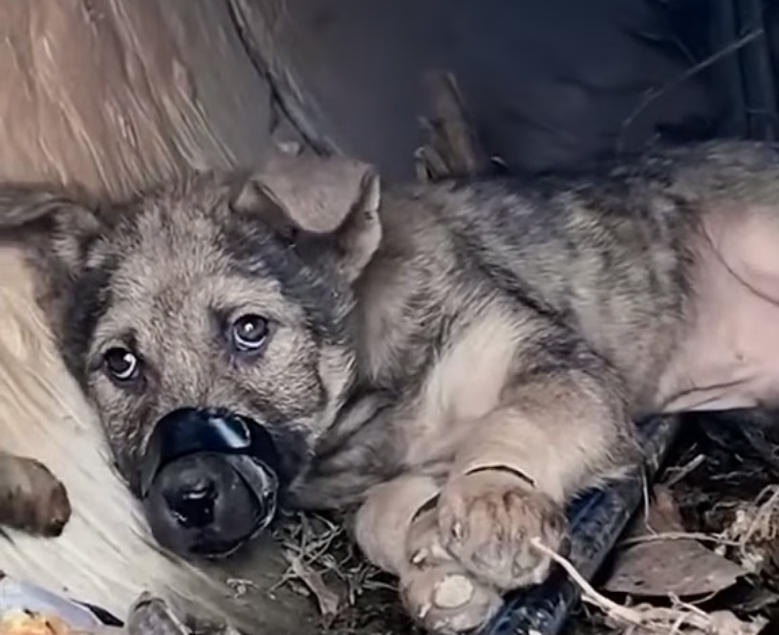
A tiny grey-and-tan puppy was lying inside.
Its scruffy fur was dirty.
Its floppy ears were lowered.
Its small body trembled.
Emma crouched down.
“Oh, sweetheart…”
The puppy looked at her.
Then it began crying again.
Emma carefully looked around the pipe.
There was no mother.
No other puppy.
No food.
No water.
Only dry leaves, dirt, and pieces of plastic.
The puppy appeared exhausted.
It was using the pipe as a shelter because there was nowhere else to go.
Emma slowly extended her hand.
The puppy backed farther into the darkness.
She stopped immediately.
“It’s okay.”
“I won’t hurt you.”
The puppy continued whimpering.
But it didn’t run.
Perhaps it was too tired.
Perhaps it was simply waiting for someone to help.
Emma called a local animal rescue team.
While waiting, she placed a shallow bowl of water near the entrance.
The puppy stared at it.
For several seconds, it didn’t move.
Then its nose began to twitch.
It slowly crawled forward.
One paw.
Then another.
It reached the water.
The puppy drank.
Slowly at first.
Then more quickly.
Emma watched quietly.
“You must have been so thirsty.”
The puppy lifted its head.
Water dripped from its nose.
Then it looked directly at Emma.
The rescue team arrived shortly afterward.
A rescuer named Daniel approached the pipe.
He crouched near the entrance.
The puppy immediately became nervous.
It tried to move backward.
Daniel stopped.
“We’ll take it slowly.”
He placed a soft blanket near the entrance.
Then sat down several feet away.
He didn’t try to grab the puppy.
Instead, he waited.
The puppy watched him.
The wind moved through the pipe.
The dry leaves rustled.
The puppy shivered.
Daniel spoke softly.
“You’re safe.”
“You don’t have to hide anymore.”
Minutes passed.
The puppy slowly moved toward the blanket.
It sniffed the fabric.
Then stopped.
Daniel remained still.
The puppy took another step.
Then another.
Finally, it placed both front paws on the blanket.
Daniel smiled.
“That’s it.”
The puppy looked at him.
For the first time, its crying became quieter.
Daniel gently moved closer.
He could see how thin the puppy was.
Its ribs were faintly visible beneath the dirty fur.
Its paws were covered in dust.
Its body was trembling from exhaustion.
Daniel carefully wrapped the blanket around it.
The puppy stiffened.
Then relaxed.
Its head rested against his arm.
Daniel whispered:
“I’ve got you.”
The puppy closed its eyes.
The rescue team carefully carried the puppy out of the pipe.
As soon as it reached the daylight, it squinted.
The bright sky seemed unfamiliar.
The puppy looked around.
For perhaps the first time, it could see beyond the darkness.
There was grass.
Trees.
Open sky.
And people standing nearby.
No one was trying to hurt it.
No one was chasing it away.
It was safe.
They placed the puppy inside a warm rescue vehicle.
The puppy was wrapped in another blanket.
A small bowl of food was placed nearby.
It sniffed.
Then ate.
The rescuers watched quietly.
The puppy ate slowly, stopping several times to rest.
But eventually, the entire small meal was gone.
Daniel smiled.
“Good boy.”
They named him Buddy.
At the veterinary clinic, Buddy was examined immediately.
He was severely underweight and dehydrated.
His fur was dirty and matted.
His paws were sore from walking on rough ground.
But there were no major injuries.
The veterinarian said that with proper care, he had a good chance of recovering.
Buddy was given fluids.
His fur was carefully cleaned.
Then he was placed beneath a warm blanket.
He fell asleep almost immediately.
That night, Buddy slept peacefully.
The room was quiet.
No traffic.
No wind blowing through concrete.
No cold dirt.
No plastic wrappers.
No darkness.
Just warmth.
A volunteer checked on him.
Buddy opened his eyes.
He lifted his head.
Then rested it again.
The volunteer smiled.
“Sleep, little one.”
“You’re safe now.”
The next morning, Buddy stood.
His legs were shaky.
But he stood.
The veterinarian placed food in front of him.
Buddy ate.
Then drank.
Afterward, he looked around the room.
He noticed a small toy.
He walked toward it.
Sniffed it.
Touched it with one paw.
The toy rolled away.
Buddy followed.
It was the beginning of something new.
Over the next few weeks, Buddy became stronger.
His fur slowly became soft again.
His eyes became brighter.
His appetite returned.
He began playing.
At first, he was nervous around people.
Whenever someone moved suddenly, he would hide.
But the rescuers never forced him.
They gave him time.
Every day, they sat beside him.
Every day, they spoke softly.
And every day, Buddy trusted them a little more.
One afternoon, Daniel sat on the floor beside Buddy.
Buddy walked toward him.
He stopped.
Looked at Daniel.
Then gently placed his head on Daniel’s knee.
Daniel smiled.
“Are you saying thank you?”
Buddy wagged his tail.
Daniel scratched behind his ears.
Buddy closed his eyes.
Then he began to purr softly in his own puppy-like way.
The frightened animal from the drainage pipe was beginning to understand what love felt like.
Eventually, Buddy was taken outside.
The rescue center had a small garden.
There was grass.
Trees.
Sunlight.
A few toys.
Buddy stepped outside.
He stopped.
He looked around.
Then he sniffed the grass.
A butterfly flew past.
Buddy followed it.
Then another.
Suddenly, he began running.
His ears bounced.
His tail wagged.
He ran in circles around the garden.
The rescuers laughed.
The little puppy who once cried inside a concrete pipe was finally running beneath the open sky.
One day, a family visited the rescue center.
A young girl named Lily walked into the garden.
Buddy saw her.
He approached slowly.
Lily crouched down.
She didn’t grab him.
She simply held out her hand.
Buddy sniffed it.
Then he placed his nose against her palm.
Lily smiled.
“Hi, Buddy.”
Buddy wagged his tail.
He sat beside her.
When Lily stood, Buddy followed.
When she sat down, he sat beside her.
The family stayed for almost an hour.
Buddy never left Lily’s side.
Before they left, Lily hugged him gently.
Buddy rested his head against her shoulder.
Lily whispered:
“Can we bring him home?”
Her parents smiled.
They already knew the answer.
A few days later, Buddy left the rescue center.
His new home had a soft bed.
Fresh water.
Food.
Toys.
And a garden.
Buddy explored everything.
He sniffed the flowers.
Chased a ball.
Ran across the grass.
Then he found a small fabric tunnel.
He crawled inside.
Everyone laughed.
For a moment, Buddy disappeared into the darkness.
Then he came running back out.
His tail was wagging.
That evening, Buddy slept beside Lily.
She gently covered him with a blanket.
Buddy sighed peacefully.
Outside, the wind moved through the trees.
The sound reminded him of the old drainage pipe.
But this time, the wind didn’t surround him in darkness.
He was lying in a warm room.
Someone was beside him.
He was safe.
Months passed.
Buddy became a happy, energetic dog.
He loved playing fetch.
He loved sleeping on the sofa.
He followed Lily everywhere.
Whenever she came home from school, Buddy ran to the door.
His tail wagged so hard that his entire body moved.
Lily would kneel down.
Buddy would jump into her arms.
It was difficult to believe that this was the same puppy who once couldn’t stop crying inside a concrete pipe.
One afternoon, Lily and Buddy went for a walk near the countryside.
They passed another concrete drainage pipe.
Buddy stopped.
He stared at the dark entrance.
Lily noticed.
She crouched beside him.
“It’s okay, Buddy.”
Buddy looked inside.
For a moment, he remained completely still.
Perhaps he remembered.
The cold.
The darkness.
The hunger.
The loneliness.
The endless crying.
Then Lily called his name.
“Buddy.”
He turned around.
She held out his favorite ball.
Buddy’s ears lifted.
His tail began to wag.
He ran toward her.
He didn’t need to go back.
He didn’t need to hide.
He didn’t need to cry anymore.
That pipe was part of his past.
His future was somewhere else.
With his family.
With his warm bed.
With his favorite toys.
With the people who loved him.
That night, Buddy slept beside Lily again.
His paws moved slightly as he dreamed.
Maybe he was running through the garden.
Maybe he was chasing butterflies.
Maybe he was playing with his favorite ball.
Whatever he dreamed about, there was no fear anymore.
Because the little puppy who once cried endlessly in the darkness had finally discovered something beautiful.
Someone had heard him.
Someone had stopped.
Someone had reached inside the darkness.
Someone had carried him into the light.
The concrete pipe was still there.
The road was still there.
The dry leaves still blew across the ground.
But Buddy was no longer there.
He was home.
Warm.
Healthy.
Loved.
And when he woke up the next morning, he didn’t hear the sound of wind echoing through concrete.
He heard Lily laughing.
He heard the sound of his food bowl.
And when he ran outside, he heard birds singing in the trees.
Buddy lifted his head.
His tail wagged.
Then he ran across the grass.
The little puppy who once cried from the darkness had finally found the light.
He had been rescued.
He had been given a second chance.
And most importantly, he had finally found a place to call home.
The 2026 Rolls-Royce Phantom Series II: A Strategic Guide to the Ultimate Real Estate Investment on Wheels
In the rarified world of ultra-luxury assets, the Rolls-Royce Phantom Series II does not merely exist as a motor car; it stands as a mobile piece of high-yield real estate. As we navigate the financial landscape of 2026, the distinction between a “car” and an “appreciating bespoke asset” has never been more critical. Having spent over a decade advising high-net-worth individuals on luxury acquisitions, I have seen many buyers mistake a vehicle for a simple depreciating liability. However, the Phantom Series II—particularly in its 2026 iteration—defies standard automotive logic.
For those evaluating the cost of entry versus the long-term refinancing potential and residual value of a bespoke masterpiece, the current market offers a unique window. The Series II represents the pinnacle of the internal combustion era, making it a “legacy buy” for collectors and a savvy strategic move for those looking to park capital in a tangible, liquid luxury asset.
The 2026 Evolution: What Has Changed?
The Rolls-Royce Phantom Series II maintains the iconic silhouette that defines the pinnacle of motoring, but the 2026 updates focus on “meaningful permanence.” The most striking visual update is the polished horizontal line connecting the daytime running lights above the Pantheon Grille. This creates a grounded, wider stance that commands the road.
Furthermore, the grille is now subtly illuminated—a feature borrowed from the Ghost but executed here with far more restraint. The headlights feature intricate laser-cut bezel starlights, mirroring the famous Starlight Headliner found in the cabin. These aren’t just aesthetic choices; they are value-drivers. In my experience, “Bespoke” features like these account for nearly 30% of a vehicle’s resale premium in the secondary market.
Key Aesthetic and Functional Enhancements:
The Black Badge Influence: For the first time, clients can commission darkened chrome grille surrounds and black bonnet reins, catering to a younger demographic of investors who prefer “stealth wealth” over traditional chrome.
1920s Disc Wheels: A nod to the brand’s heritage, these wheels are available in polished stainless or black lacquer, significantly impacting the car’s presence and future “classic” status.
Rolls-Royce Connected: A seamless integration with the ‘Whispers’ app, allowing owners to send destinations directly to the car’s navigation from their smartphones—a must-have for the modern, tech-savvy executive.
Should You Buy, Wait, or Lease?
One of the most frequent questions I receive from clients is whether they should pull the trigger on a Rolls-Royce Phantom Series II now or wait for the inevitable full-electrification of the flagship line.
The Case for Buying Now (2026)
We are currently at the “Golden Peak” of V12 engineering. As global regulations tighten, the scarcity of a twin-turbo 6.75-liter V12 engine will only drive prices upward in the collector market.
Mortgage Rates and Financing: With stabilized mortgage rates influencing the broader luxury credit market, securing a home loan style asset-backed line of credit to purchase a Phantom is currently a highly efficient use of capital.
Investment Perspective: Think of the Phantom Series II as a “buy and hold” stock. While most cars lose 20% the moment they leave the lot, a highly bespoke Phantom—like the Platino or Metropolitan Collection editions—often holds a significant portion of its MSRP due to its “1 of 1” nature.
The Case for Waiting
The only reason to wait is if your lifestyle requires a purely electric powertrain (the Spectre’s influence). However, the Phantom is about presence and vibrationless power—something the V12 has perfected over decades. Waiting may result in missing the last “pure” iteration of this legend.
Case Study: The “Bespoke” Dividend
Investor A purchased a standard-spec Phantom in 2023 for approximately $500,000.
Investor B worked with a consultant to commission a Phantom Series II Platino in 2026, opting for the bamboo-fiber interior and a custom “Metropolitan” marquetry dashboard, totaling $650,000.
Two years later, Investor A’s car is worth $410,000 (an 18% drop). Investor B’s car, because of its unique materials and “Platino” designation, fetches $630,000 at a specialized auction like RM Sotheby’s.
The Lesson: In the world of Rolls-Royce, the higher the initial cost of bespoke customization, the lower the actual “cost of ownership” due to value retention.
What This Means for You: Financial Strategies for 2026
If you are looking at the pricing of a new Phantom, you aren’t just looking at a sticker price; you are looking at a capital allocation.
Refinancing Opportunities: Many of my clients use the Phantom as collateral. Because of its steady value, specialized lenders offer competitive refinancing terms that allow you to pull liquidity out of the car to fund other real estate investments.
Tax Considerations: Depending on your jurisdiction and how the vehicle is registered (e.g., for a high-end concierge business or a private family office), there may be significant depreciation benefits or Section 179 deductions available in 2026.
Insurance Optimization: Standard insurance will not suffice. You need an “Agreed Value” policy. In 2026, premiums for these assets have become more competitive as data shows Phantom owners are among the lowest-risk drivers globally.
Mistakes to Avoid That Could Cost You Money
I have seen seasoned investors lose six figures on a Rolls-Royce acquisition by making these three mistakes:
Over-Personalization: While Bespoke is good, “Wild” is bad. If you choose a neon-pink interior, your resale market drops to zero. Stick to sophisticated themes like the Metropolitan Collection, which uses 500 individual wood pieces to create a city skyline. It is art; art appreciates.
Neglecting the “Whispers” Ecosystem: Not setting up the Rolls-Royce Connected features can actually hurt the car’s tech-pedigree when you go to sell it. The 2026 buyer expects a smart car.
Ignoring the Extended Wheelbase: If you intend to be chauffeured, the Phantom Extended is the only choice. The price difference is negligible compared to the massive increase in desirability for the “Rear Seat Experience” market.
Cost Breakdown: 2026 Market Estimates
| Feature / Model | Estimated Cost (USD) | Value Retention (5-Year) |
|---|---|---|
| Phantom Series II (Base) | $500,000+ | Moderate (60%) |
| Phantom Extended | $580,000+ | High (75%) |
| Bespoke Platino Package | +$120,000 | Very High (85%+) |
| Annual Maintenance/Insurance | $15,000 – $25,000 | N/A |
Best Financial Strategies Right Now
In 2026, the best options involve leveraging the current mortgage rates to keep your cash in higher-yield investments while using low-interest luxury auto loans to acquire the car. I often tell my clients: “Why use your own $600,000 when you can use the bank’s at 5% and keep your $600,000 earning 10% in a diversified REIT?”
Additionally, consider the comparison between the Phantom and its competitors. While the Maybach is a fine car, it does not possess the “Veblen Good” status of the Rolls-Royce. The Phantom is price-inelastic; its demand does not drop when the price rises, making it a safer “hedge” against inflation.
The Verdict: A Legacy Asset for the Modern Era
The Rolls-Royce Phantom Series II remains the undisputed “best car in the world,” but in 2026, it is also one of the smartest places to put your money if you understand the nuances of the bespoke market. Whether it’s the silk-and-bamboo interior of the Platino or the skyscraper-themed embroidery of the Metropolitan, these cars are functional galleries.
If you are weighing the cost against the prestige, remember that you aren’t just buying a mode of transport—you are securing a seat at the most exclusive table in the world.
Ready to elevate your portfolio? [Compare Bespoke options and check current financing rates with our specialist team today. Explore the 2026 Phantom Collection and discover how a masterpiece can become your best-performing asset.]