The morning was unusually quiet.
A soft breeze moved through the trees surrounding the small wooden house. Leaves rustled gently in the distance, and warm daylight spread across the porch floor.
Everything seemed peaceful.
Then came a tiny sound.
Chirp… chirp…
It was so faint that someone could easily mistake it for the sound of a distant bird.
But the sound came from the porch.
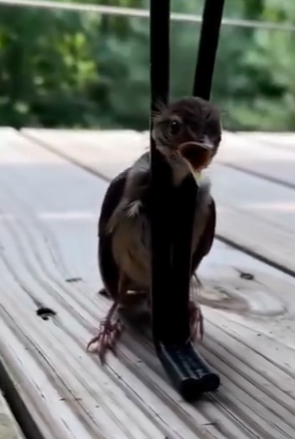
A tiny wild bird was perched on a black metal rod near the wooden floor.
Its delicate brown feathers were slightly ruffled.
Its slender legs trembled in the cold breeze.
Its bright eyes constantly scanned the surroundings.
Every few seconds, it opened its tiny beak and released another fragile chirp.
Chirp… chirp…
It sounded like a desperate call for help.
The homeowner, a woman named Emma, heard the sound while opening her glass door.
She stopped immediately.
She looked around.
At first, she couldn’t see anything.
Then she noticed the tiny bird.
It was sitting completely still on the metal rod.
Emma slowly stepped closer.
The bird didn’t fly away.
That frightened her.
A healthy wild bird would normally escape immediately when a person approached.
Instead, this little bird simply remained there, trembling.
Emma crouched several feet away.
“Are you hurt?”
The bird opened its beak.
Another tiny chirp escaped.
Emma looked carefully around the porch.
There was no nest.
No other bird nearby.
No obvious shelter.
The little creature appeared completely alone.
Emma didn’t want to scare it.
She went back inside and called a local wildlife rescue organization.
While waiting, she placed a shallow container of water nearby.
Then she moved away.
The bird looked toward the water.
But it didn’t move.
The wind became stronger.
Its tiny feathers fluttered.
The bird shivered again.
Emma realized that it was probably exhausted.
Perhaps it had fallen from a nearby nest.
Perhaps it had been separated from its parents during a storm.
She didn’t know.
But she knew one thing.
She couldn’t simply leave it there.
The rescue volunteer arrived about twenty minutes later.
His name was Daniel.
He carried a small wildlife carrier, a soft towel, and protective gloves.
He approached slowly.
The bird watched him.
Its tiny body trembled.
Daniel stopped several feet away.
“Easy, little one.”
He didn’t reach for it immediately.
Wild birds can become extremely frightened when people move too quickly.
Daniel observed its posture.
The bird appeared weak.
Its feathers were slightly disorganized, and it wasn’t attempting to fly.
That was a worrying sign.
Daniel moved closer.
The bird tried to shift along the metal rod.
It managed only a few centimeters.
Then stopped.
Its tiny claws tightened around the metal.
It chirped again.
Daniel looked up toward the trees.
He searched for a nest.
Nothing.
He checked the roofline.
Nothing.
He looked around the garden.
Still nothing.
There was no obvious sign of the bird’s parents.
The rescue volunteer gently prepared the carrier.
“We’re going to get you somewhere warm,” he whispered.
When Daniel finally reached toward the bird, it became frightened.
Its wings opened.
For one second, it tried to fly.
But it couldn’t gain enough strength.
It dropped slightly.
Daniel immediately supported it with the soft towel.
The bird fluttered weakly.
Then became still.
He carefully wrapped the towel around its body, leaving enough room for it to breathe comfortably.
The tiny bird’s heart was beating rapidly.
Daniel could feel the delicate movement beneath the feathers.
“It’s okay.”
“You’re safe.”
The bird opened its beak.
A tiny chirp came from inside the towel.
Daniel placed the bird inside the wildlife carrier.
Emma watched anxiously.
“Will it be okay?”
“We’ll give it the best chance we can,” Daniel replied.
The carrier was placed somewhere warm and quiet.
The bird was examined carefully.
There were no obvious broken wings.
That was good news.
But it was severely exhausted.
The rescue team believed it had probably been exposed to cold and wind for several hours.
It needed rest.
Warmth.
Water.
And careful monitoring.
That evening, the tiny bird remained quiet.
It barely moved.
Emma returned to check on it.
She sat several feet away from the carrier.
She could hear faint chirping.
Much quieter than before.
She whispered:
“You don’t have to be afraid anymore.”
The bird turned its head slightly.
Its bright eyes looked toward her.
Then it tucked its head beneath one wing.
For the first time that day, it appeared calm.
The following morning brought the first sign of hope.
The bird was standing.
Its legs were still weak.
But it was standing.
Daniel smiled.
“That’s a good sign.”
The bird hopped once.
Then again.
It looked around its temporary enclosure.
Its feathers were beginning to settle.
It drank a little water.
Later, it accepted a small amount of appropriate food from the wildlife rehabilitator.
It was still fragile.
But it was fighting.
Over the next few days, the bird grew stronger.
It began hopping from one side of the enclosure to the other.
Then it started flapping its wings.
At first, only once or twice.
Then repeatedly.
The rescue team watched carefully.
One morning, the bird suddenly flew from one perch to another.
Daniel smiled.
“Now we’re getting somewhere.”
Emma watched from outside.
She couldn’t believe the transformation.
Only days earlier, the bird had been trembling helplessly on the porch.
Now it was flying again.
But there was still one question.
Could it survive in the wild?
The rescue team didn’t want to release it too early.
They needed to make sure it could fly properly.
Find food.
Avoid danger.
And maintain its strength.
So the bird continued its rehabilitation.
Every day, it practiced.
Short flights became longer flights.
Short hops became confident movements.
Its wings became stronger.
Its chirping became louder.
Soon, the quiet little sound from the porch became a bright, energetic call.
Chirp! Chirp!
Emma smiled whenever she heard it.
Several weeks later, the rescue team decided the bird was ready.
They chose a quiet wooded area away from roads and buildings.
There were tall trees.
Dense foliage.
Natural food sources.
And plenty of shelter.
Emma was allowed to come.
She wanted to see the little bird one last time.
Daniel carried the wildlife carrier into the forest.
He placed it beneath a tree.
Then opened the door.
At first, nothing happened.
The bird stayed inside.
Emma held her breath.
Daniel waited.
The bird looked outside.
It saw the trees.
The sunlight.
The moving leaves.
The open sky.
The bird stepped forward.
One tiny hop.
Then another.
It reached the edge of the carrier.
It paused.
Its feathers moved gently in the breeze.
Then it spread its wings.
For a moment, it simply stood there.
And then—
It flew.
Straight toward the nearest tree.
Emma smiled through tears.
The bird landed on a branch.
It looked back.
Its head tilted slightly.
Daniel whispered:
“Go on.”
The bird chirped.
Then flew again.
It disappeared briefly behind the leaves.
Then its call came from somewhere above.
Chirp… chirp…
Emma looked up.
She couldn’t see it anymore.
But she could hear it.
The tiny bird that had once been trembling alone on her porch was now somewhere in the trees.
Free.
Safe.
And flying.
Emma stood beneath the tree for a long time.
She thought about how easily she could have ignored that tiny sound.
How simple it would have been to close the door and walk away.
But she hadn’t.
She had stopped.
She had listened.
And because someone listened, a tiny life had been given another chance.
The bird had arrived on the porch frightened and helpless.
It had left with strong wings.
It had gone from trembling in the cold…
to soaring beneath the open sky.
And perhaps somewhere among those trees, its tiny song was saying the only thing it could:
Thank you for hearing me.
Thank you for saving me.
Now I can fly.
The 2026 Rolls-Royce Phantom Series II: A Strategic Guide to the Ultimate Luxury Investment
In the world of ultra-high-net-worth asset management, few acquisitions carry the weight, prestige, and surprisingly resilient value of the Rolls-Royce Phantom Series II. As we move through 2026, the landscape of luxury motoring has shifted. While many manufacturers have rushed headlong into purely digital experiences, Rolls-Royce has doubled down on what I call “tactile permanence.”
Having spent over a decade advising clients on high-end automotive portfolios, I’ve seen trends come and go. I’ve seen “limitless” tech become obsolete in three years. But the Rolls-Royce Phantom Series II remains the “best car in the world” precisely because it refuses to chase fleeting fads. For the discerning investor or connoisseur in 2026, this vehicle isn’t just a means of transport; it is a bespoke sanctuary and a calculated financial move.
The Evolution of an Icon: What’s New for 2026?
The Rolls-Royce Phantom Series II represents a “subtle yet meaningful” evolution. In my experience, Rolls-Royce clients don’t want a revolution; they want perfection refined.
The most striking visual update is the new polished horizontal line resting between the daytime running lights. It provides a modern “brow” to the iconic Pantheon Grille, which is now subtly illuminated from within. The headlights feature intricate laser-cut bezel starlights, mirroring the famous Starlight Headliner found in the cabin. These aren’t just aesthetic choices; they are markers of a vehicle that maintains the highest resale value by staying visually relevant without discarding its heritage.
Furthermore, the 2026 options include a darkened chrome grille surround and black bonnet reins—features specifically requested by a younger, more “stealth-wealth” demographic. Whether you prefer the classic polished look or the new “Black Badge” inspired aesthetic, the Rolls-Royce Phantom Series II offers a level of customization that ensures your asset is one-of-one.
What This Means for You: The Financial Logic of the Phantom
When you are looking at a vehicle with a cost comfortably exceeding half a million dollars, you aren’t just buying a car; you are allocating capital. Here is how the Rolls-Royce Phantom Series II stacks up as a financial decision in 2026.
Asset Stability vs. Depreciation
While a standard luxury SUV might lose 40% of its value the moment you drive it off the lot, the Phantom exists in a different economic sphere. Because of its low production volume and the “Bespoke” nature of each build, a well-optioned Rolls-Royce Phantom Series II often experiences a much shallower depreciation curve. In many cases, specific Bespoke collections—like the “Platino” or “Metropolitan” editions—have been known to appreciate among collectors as they become “unattainable” on the primary market.
The “Connected” Advantage
The debut of ‘Rolls-Royce Connected’ in 2026 has changed the utility of the car. By linking seamlessly with Whispers (the Rolls-Royce private members’ app), owners can send destinations directly to the car, monitor its health, and access exclusive concierge services. In the high-stakes world of international business, time is the only currency you can’t print more of. The Phantom buys you that time back.
Should You Buy, Wait, or Invest?
As an industry expert, I am often asked: “Is 2026 the year to pull the trigger, or should I wait for the full electric transition?”
Buy Now If: You value the peerless V12 engine—a masterpiece of engineering that is nearing the end of its storied lifecycle. Internal combustion engines of this caliber are becoming “grandfathered” assets. Owning one of the final V12 Phantoms is akin to owning a vintage mechanical watch in a world of smartwatches.
Wait If: You are purely focused on ESG (Environmental, Social, and Governance) mandates for your corporate fleet. While the Spectre handles the electric side, the Phantom remains the choice for those who want the traditional “waftability” of gasoline power.
Invest (The Bespoke Route): If you are looking for real estate investment style returns in the automotive sector, your best bet is a Bespoke commission. High-intent buyers are currently looking for unique materials.
Expert Insight: “I recently worked with a client who wavered between a standard Phantom and a Bespoke ‘Platino’ edition. By opting for the Platino—which uses bamboo fibers and silken textiles instead of traditional leather—he secured a vehicle that was recently appraised at 15% above its original pricing due to the rarity of the materials.”
Case Study: A Tale of Two Buyers (2026 Scenario)
To understand the best financial strategies right now, let’s look at two hypothetical but realistic scenarios I’ve encountered this year.
Buyer A: The “Off-the-Lot” Traditionalist
Buyer A purchased a pre-configured Rolls-Royce Phantom Series II in a standard Diamond Black with a Seashell leather interior.
Initial Cost: $540,000
Financing: 60-month home loans style asset financing at 5.5%.
Result: While the car is magnificent, its common color scheme makes it a “commodity” in the secondary market. Expected 3-year value: $390,000.
Buyer B: The Bespoke Strategist
Buyer B commissioned a Rolls-Royce Phantom Series II with the new 3-D milled stainless steel disc wheels and a “Metropolitan” inspired marquetry interior featuring 500 individual wood veneer pieces.
Initial Cost: $620,000
Financing: Cash purchase to avoid mortgage rates fluctuations and interest overhead.
Result: Because the car is a “piece of art” with a unique 24-city time zone clock in the center console, it is highly sought after by international collectors. Expected 3-year value: $580,000+.
The Lesson: In the world of Rolls-Royce, spending more upfront on Bespoke features actually lowers your total cost of ownership by buoying the resale value.
Best Financial Strategies Right Now (2026)
If you are considering a home loan or a refinancing of other assets to acquire a Phantom, consider these expert tips for 2026:
Leverage Your Portfolio: Many of my clients use Lombard loans against their investment portfolios rather than traditional auto loans. This allows them to keep their capital working in the market while securing a lower interest rate than standard luxury car financing.
Focus on the Wheels: The new disc wheels, reminiscent of 1920s Rolls-Royces, are the “must-have” option for 2026. They are highly distinctive and are already proving to be a favorite among collectors.
The “Platino” Factor: We are seeing a massive shift toward non-leather interiors. Commissioning a Phantom with high-end textiles (like the bamboo and silk blend) is a “future-proof” move as luxury sustainability becomes a primary driver of value.
Cost Breakdown & Pricing Impact
| Component | Estimated Impact on Value | Expert Recommendation |
|---|---|---|
| Bespoke Paint | +$20,000 – $50,000 | Choose a unique “commission” color. |
| Illuminated Grille | Standard on Series II | Ensure it’s configured for maximum presence. |
| Rear Suite (Individual Seats) | +$30,000 | Essential for high resale value. |
| Starlight Headliner | +$15,000 | Non-negotiable for the “Phantom Experience.” |
When comparing best options, always prioritize the “Rear Theater Configuration.” Even if you plan on driving the car yourself (the new thicker steering wheel makes this more tempting than ever), the person who buys the car from you in five years will likely want to be chauffeured.
Mistakes to Avoid That Could Cost You Money
In my ten years of experience, I’ve seen enthusiasts make these critical errors:
Over-Tech-ing the Interior: While ‘Rolls-Royce Connected’ is vital, don’t let digital screens dominate the “Gallery” (the glass-enclosed space in the dashboard). The most valuable Phantoms are those that treat the Gallery as a place for physical art, not digital pixels.
Ignoring the “Coachline”: A hand-painted coachline (the thin stripe along the side) costs a fraction of the total price but is a hallmark of authenticity. Skipping this is a red flag to future buyers.
Poor Maintenance Records: A Rolls-Royce without a perfect service history at an authorized dealer is a financial liability. Use a specialized insurance provider that understands “agreed value” for exotic assets.
The Verdict: A Masterpiece of Financial and Aesthetic Logic
The Rolls-Royce Phantom Series II is not just a car. In 2026, it serves as a hedge against the mundane. Whether it’s the “Platino” edition’s revolutionary fabrics or the “Metropolitan” collection’s intricate marquetry of cityscapes, these vehicles represent the pinnacle of human craftsmanship.
From a real estate investment perspective, think of the Phantom as a “mobile penthouse.” It offers the same exclusivity, the same appreciation potential for unique builds, and the same level of status. If you are looking for the best options in the 2026 market to park your capital, the Phantom remains the gold standard.
Take the next step in your journey. To explore the latest Bespoke opportunities or to compare options and check rates for bespoke financing, visit your local Rolls-Royce atelier today and begin commissioning your legacy.