


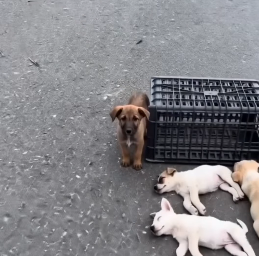
The road was almost completely empty beneath the gloomy afternoon sky.
A narrow stretch of asphalt cut through the countryside, bordered by metal railings, tall grass, and a few scattered trees. The wind moved gently through the roadside weeds, carrying the distant sound of passing vehicles.
Then there was another sound.
A tiny whimper.
Near an overturned black plastic bin, a small brown puppy stood trembling on the rough pavement.
Behind him, several white and light-brown puppies lay scattered across the roadside.
They were motionless.
Too weak to stand.
The brown puppy kept looking from one puppy to another.
He would walk toward them, sniff their faces, then gently nudge them with his nose.
One puppy moved slightly.
The brown puppy’s tail wagged.
He turned toward the road, as if searching for someone.
Then he returned to his companions.
He refused to leave.
Nobody knew how the puppies had ended up there.
A local resident later said that the black bin had been found overturned earlier that morning.
At first, nobody thought anything of it.
Then, as the afternoon became quieter, a passerby heard faint crying near the roadside.
The sound was almost impossible to hear over the wind and traffic.
But the passerby stopped.
He walked toward the railing.
And then he saw them.
Several tiny puppies lying on the asphalt.
His heart sank.
He immediately called an animal rescue organization.
When the rescuers arrived, they approached slowly.
The brown puppy noticed them first.
He stood in front of the other puppies.
His tiny body was trembling, but he didn’t run.
He simply stared.
One rescuer knelt several meters away.
“Hey, little one.”
The puppy didn’t move.
The rescuer slowly removed his gloves and placed them on the ground.
Then he put down a bowl of water.
The brown puppy sniffed the air.
His stomach was clearly empty.
But he didn’t approach the food.
Instead, he looked back at the puppies lying behind him.
The rescuer understood.
The little dog wasn’t thinking about himself.
He was waiting for his friends to be helped first.
One rescuer slowly moved toward the nearest white puppy.
The puppy barely responded.
He gently placed a hand against its chest.
There was a faint heartbeat.
“She’s alive.”
The team immediately began working.
Each puppy was carefully examined.
They were severely dehydrated, dangerously underweight, and exhausted from exposure.
The smallest puppy was so weak that it could barely lift its head.
The rescuers wrapped the puppies in warm blankets one by one.
The brown puppy watched every movement.
Whenever one of the puppies was carried away, he became anxious.
He followed as far as his tiny legs allowed.
Then he returned to the others.
Finally, a rescuer reached for him.
The puppy stepped backward.
For a moment, he looked terrified.
Then he glanced at the last puppy lying on the pavement.
He seemed to make a decision.
He walked forward.
The rescuer gently picked him up.
The puppy rested his head against the man’s arm.
He didn’t struggle.
The rescuers transported all of the puppies to an emergency veterinary clinic.
The clinic immediately became busy.
Warm blankets covered the examination tables.
Small bowls of fluids and food were prepared.
Veterinarians checked each puppy carefully.
The brown puppy was given the name Bruno.
The smallest white puppy was named Snow.
The other puppies were named Milo, Cloud, and Biscuit.
The names were simple.
But to the rescuers, they meant something important.
These puppies were no longer anonymous animals beside a trash bin.
They were individuals.
They mattered.
That first night was frightening.
Snow was the weakest.
She barely moved.
Her breathing was shallow.
A veterinarian stayed nearby and monitored her throughout the night.
Bruno refused to sleep.
He kept lifting his head whenever someone approached Snow.
Whenever a volunteer placed food near him, he ignored it until Snow had been checked.
Eventually, the veterinarian placed the puppies together in a warm recovery area.
Bruno immediately curled around Snow.
His tiny body became a shield around hers.
Snow moved her nose against his chest.
Bruno finally closed his eyes.
For the first time that day, the room became quiet.
The next morning brought the first sign of hope.
Snow lifted her head.
Only slightly.
But she did it.
A volunteer noticed immediately.
“Look.”
Bruno opened his eyes.
He touched his nose to Snow’s face.
Snow blinked.
Then she made a tiny sound.
Bruno’s tail began wagging.
The volunteer smiled through tears.
They were still fighting.
All of them.
Recovery was slow.
The puppies couldn’t eat large meals.
They were given small amounts of food several times a day.
They slept most of the time.
But every day brought another small improvement.
Milo stood first.
Then Cloud.
Biscuit discovered how to play with a blanket.
Snow eventually managed to take a few shaky steps.
And Bruno became the most energetic of them all.
He ran between the others, checking on everyone.
If one puppy was sleeping, he would sniff them.
If one puppy cried, he would go over.
If someone was frightened, Bruno would lie beside them.
The rescuers began joking that Bruno believed he was their little guardian.
Perhaps he did.
Several weeks later, the puppies were strong enough to play outside.
The rescue center had a small fenced yard.
When the gate opened, Bruno stepped onto the grass.
He stopped.
He looked around.
Then he ran.
His paws flew across the grass.
Milo followed.
Cloud chased Biscuit.
Snow stumbled behind them.
Bruno immediately slowed down.
He waited.
When Snow caught up, he continued running.
The rescuers watched from the doorway.
It was difficult to believe that these were the same puppies they had found lying helpless beside an overturned bin.
There were no trash bags now.
No cold asphalt.
No distant traffic.
Only sunshine, grass, toys, and five little puppies discovering what childhood was supposed to feel like.
As the puppies grew, the rescue center began receiving adoption requests.
Many families wanted them.
But the rescuers were determined to make sure they would never experience abandonment again.
The puppies were eventually placed in loving homes.
Some were adopted together.
Others went to carefully selected families where they would be safe and loved.
Bruno was the last one waiting.
He had spent so much of his short life protecting everyone else that he seemed unsure what to do when there was nobody left to protect.
Then a couple named Daniel and Maria came to the rescue center.
They had read Bruno’s story.
When they entered the yard, Bruno stood quietly near the fence.
Maria crouched down.
Bruno approached slowly.
He sniffed her hand.
Then he rested his head against her knee.
Maria gently stroked his ears.
Bruno closed his eyes.
For several seconds, neither of them moved.
Then his tail began to wag.
Maria looked at Daniel.
“We’re taking him home.”
That evening, Bruno entered his new house.
There was a soft bed waiting for him.
A bowl filled with fresh food.
Clean water.
A pile of toys.
And a warm blanket.
He walked through every room carefully.
Then he found the backyard.
Green grass stretched beneath the evening sky.
Bruno stepped outside.
He sniffed the ground.
He looked toward the fence.
Then toward his new family.
His tail wagged.
He suddenly ran across the yard.
Daniel laughed.
Maria followed him.
Bruno chased a small ball for the first time.
When he finally became tired, he curled up on the grass.
Maria sat beside him.
Bruno rested his head against her leg.
The same little puppy who had once stood beside an overturned trash bin, desperately trying to keep his companions alive, was finally able to close his eyes without fear.
He didn’t have to watch the road anymore.
He didn’t have to listen for rescuers.
He didn’t have to protect everyone by himself.
Someone was protecting him now.
And somewhere behind him, the painful memory of that empty roadside was slowly becoming just that—a memory.
Bruno had been abandoned.
But he had not been forgotten.
He had been found.
He had been saved.
And after everything he had endured, the little brown puppy finally had something he had been waiting for since the day he was left behind.
A home. A family. And a promise that he would never be alone again.
The 2027 Mercedes-Maybach S-Class: Ultra-Luxury and the Return of the V-12 Engine
Published on Mar 25, 2026 at 7:04 PM (UTC+4)
by Henry Kelsall
Last updated on Mar 26, 2026 at 9:19 PM (UTC+4)
Edited by Emma Matthews
The 2027 Mercedes-Maybach S-Class just dropped with a V-12, a superscreen and cupholders built exclusively for silver-plated flutes
Google
Well, we had a teaser not long ago, but finally, the 2027 Mercedes-Maybach S-Class has been unveiled, and gearheads will rejoice that a V12 is under the hood of the luxury car.
Mercedes had released teaser images and video of the new car recently, but this is our first full look at the new luxury S-Class.
As you would expect, opulence and luxury abound in the new sedan, with all the trimmings you’d expect from a high-end luxury car like this.
But possibly the biggest news is that there is no hybrid or electric motor in here, just good old-fashioned V12 power.
Enter our competition to win a stunning 2006 Ford GT or $400,000 cash!
This is what sits under the hood of the 2027 Mercedes-Maybach S-Class
Ford created a phenomenal and advanced concept car in 1983 that spear-headed a lot of the features cars have today
Published on Apr 06, 2026 at 4:15 PM (UTC+4)
by Henry Kelsall
Last updated on Apr 02, 2026 at 2:12 PM (UTC+4)
Edited by Emma Matthews
Ford created a phenomenal and advanced concept car in 1983 that spear-headed a lot of the features cars have today
Google
Once upon a time, a relatively well-known car company by the name of Ford came up with an advanced concept car that inadvertently set some of the blueprints for today’s cars.
It would become one of the most influential concepts of all time, and preview a whole host of advanced features for modern motorists.
Enter the 1983 Probe IV Concept by Ghia, a striking car that still looks modern even as we write this in 2026.
Here’s what makes this car so special.
Enter our competition to win a stunning 2006 Ford GT or $400,000 cash!
This is how Ford created the advanced concept car
Ford wanted to push the envelope of what was possible with cars at the time.
It had already done this with cars such as the Ford Nucleon from 1958.
The Probe was actually part of a series of concept cars, with Probe I making its debut in 1979.
Probe II and Probe III soon followed, before Probe IV arrived in 1983.
This is the car that pushed the series to the absolute limit.
Shown at that year’s Detroit Auto Show, it had an ultra-low drag coefficient of 0.15.
This was as low as the fighter jets of the time.
Ford created a phenomenal and advanced concept car in 1983 that spear-headed a lot of the features cars have today
Bring a Trailer
The Probe IV had an automatic attitude-control system, lowering the car on the highway.
On city streets, the ride height would rise from three inches to six inches.
Ghia worked on the styling, leading to an incredibly dramatic-looking concept car.
The Blue Oval built two examples of the Probe IV.
Why the Probe IV was the blueprint for modern cars
Efficiency is the name of the game in 2026, especially when it comes to EVs and hybrids.
So Ford and Ghia were really ahead of the curve with the Probe of 1983.
Also prominent are the headlights, front bucket seats, and a digital instrument display.
Ford created a phenomenal and advanced concept car in 1983 that spear-headed a lot of the features cars have today
Bring a Trailer
Back in the early 1980s, analogue displays were still the norm.
The overall appearance of the car was also more advanced than the concepts that had come before it.
For example, the Probe I was constructed using a Mustang Fox-body muscle car.
Ford created a phenomenal and advanced concept car in 1983 that spear-headed a lot of the features cars have today
Bring a Trailer
Probe II was far more conventional, while Probe III was remarkably similar to the Ford Sierra.
But it was Probe IV, which did come up for sale recently, that really caught the eye of the public.
Incredibly, this advanced concept car still looks futuristic today, some 43 years after it was built.
Ford created a phenomenal and advanced concept car in 1983 that spear-headed a lot of the features cars have today
SB Media/Google Gemini
DISCOVER SBX CARS: The global premium car auction platform powered by Supercar Blondie
Cars
This is everything you shouldn’t do when driving a manual car with a lot of common habits that’ll cause expensive repairs
Published on Apr 06, 2026 at 2:52 PM (UTC+4)
by Callum Tokody
Last updated on Apr 07, 2026 at 8:13 PM (UTC+4)
Edited by Emma Matthews
This is everything you shouldn’t do when driving a manual car with a lot of common habits that’ll cause expensive repairs
Google
Operating a manual car with a light touch is the only way to avoid devastating engine strain and the kind of clutch repairs that typically cost thousands of dollars.
Most drivers unknowingly grind down their transmission components every time they pull away from a light or rest their hand on the shifter.
These small, repetitive mechanical insults accumulate until the vehicle eventually leaves you stranded with a massive repair invoice.
Your daily driving style is currently deciding exactly how much life is left in your gearbox – here’s how to keep it going for longer.
Stop killing your manual car
The release bearing is a small part that often dictates the timing of major clutch repairs in a manual car.
Many drivers often leave their foot hovering on the pedal. This applies enough pressure to engage the bearing against the pressure plate.
This constant contact generates friction and heat that the part cannot handle during normal driving.
Once the bearing fails, the repair requires removing the entire gearbox. This leads to high labor costs.
Most service centers recommend a full replacement of the clutch kit and flywheel once the system is open.
A newly revealed Porsche patent could help the beloved manual transmission survive in an era increasingly dominated by automation and electrification.
Porsche
Resting a hand on the gear stick presents another significant mechanical risk to the transmission.
A gear stick connects to a selector fork that sits millimeters away from a rotating collar inside the gearbox.
Constant downward pressure forces these metal parts together and causes the fork to wear thin prematurely.
Replacing a worn selector fork often costs more than a thousand dollars due to the complexity of the internal assembly.
Drivers should also avoid selecting first gear at speeds above five miles per hour.
Learn how to protect your manual car from devastating engine strain and avoid expensive clutch repairs by mastering these simple professional driving habits today
This gear has a steep ratio that puts extreme stress on the internal rings as they attempt to match the speed of the wheels.
Forcing the gear in quickly bypasses the natural timing of the system.
This leads to notched shifting or gear lockout. Using the gear stick gently allows the internal components to align properly without unnecessary force.
These small changes help you avoid the most frequent and expensive clutch repairs seen in modern workshops.
End the engine strain nightmare
Properly managing engine strain is essential for protecting the longevity of the crankshaft and internal bearings.
Lugging occurs when a driver applies full throttle at low revs while the car is in a high gear. This, in turn, creates high pressure inside the engine without the benefit of rapid oil circulation or cooling flow.
This kind of chronic engine strain can lead to hardware fatigue and reduced fuel efficiency over the life of the vehicle.
To avoid this, downshift to maintain an optimal power band for acceleration.
Next up – thermal management. This is equally important when navigating hills or heavy traffic.
Holding a vehicle stationary on an incline using only the clutch generates immense heat between the friction surfaces.
Learn how to protect your manual car from devastating engine strain and avoid expensive clutch repairs by mastering these simple professional driving habits today
Supercar Blondie / ChatGPT
This practice causes the clutch material to glaze or warp. That damage eventually means more clutch repairs. But using the handbrake to hold the car still allows the transmission to stay cool and fully disengaged.
You probably won’t be surprised to hear this, but smooth gear changes also reduce the shock load sent through the drivetrain and engine mounts.
Some drivers drop the pedal quickly to avoid slippage, but the resulting jolt causes different types of mechanical stress.
A controlled engagement allows the shock springs in the clutch disk to absorb the transition properly.
These technical adjustments ensure that your manual car remains in peak condition while avoiding the high costs associated with transmission neglect.
Your driving habits ultimately dictate whether a gearbox lasts for the life of the car or fails prematurely.
But you can minimize engine strain by staying in the correct gear for your current road speed