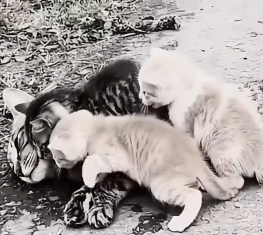



The highway stretched endlessly beneath a cold gray sky. Cars rushed past at terrifying speeds, each one creating a violent gust of wind that shook the tiny golden-brown dog sitting beside the steel guardrail.
No one stopped.
The little dog curled itself into a tight ball on the rough asphalt shoulder. One of its hind legs was badly injured, forcing it to drag itself only a few inches whenever another truck thundered by. Every movement made it tremble with pain.
Its eyes never left the road.
It wasn’t looking for food.
It wasn’t begging for help.
It was waiting.
Hours earlier, witnesses would later explain, an old pickup truck had suddenly stopped on the emergency lane. A man stepped out carrying the small dog wrapped in an old blanket.
For a brief moment, the dog’s tail wagged happily.
It believed they were taking a walk.
Instead, the man gently placed it beside the guardrail, returned to his truck, and drove away.
The little dog chased after the truck with all the strength it had.
Only a few painful steps.
Then it collapsed.
From that moment on, it simply waited where it had been left.
Every engine sound made its ears stand up.
Every approaching vehicle filled it with hope.
Every passing truck broke its heart again.
Rain slowly began to fall.
The blanket became soaked.
The temperature dropped.
Still, the little dog refused to leave the spot.
Late that afternoon, a highway maintenance worker noticed something unusual while inspecting the guardrail. At first he thought it was discarded trash.
Then he saw two frightened eyes staring back at him.
He immediately called a local animal rescue organization.
Within twenty minutes, a rescue van arrived.
The rescuers parked safely behind the emergency lane, activated warning lights, and carefully watched the traffic before approaching.
The little dog tried to stand.
Its tail wagged weakly.
Then fear suddenly overwhelmed it.
Perhaps too many people had disappointed it before.
It attempted to crawl away, dragging its injured leg across the asphalt.
One rescuer quietly knelt several meters away.
She didn’t rush.
She didn’t reach out immediately.
Instead, she softly spoke to the frightened dog.
“It’s okay… we’re not leaving you.”
The dog froze.
Its ears twitched.
Slowly, the rescuer placed a bowl of water nearby.
The exhausted dog hesitated for nearly a minute before taking tiny steps toward it.
Its entire body shook.
When it finally lowered its head to drink, another rescuer quietly slipped a soft blanket underneath its body.
No sudden movements.
No loud voices.
Only patience.
The tiny dog looked up.
For the first time all day, its eyes softened.
As they gently lifted it into a rescue stretcher, the little dog didn’t struggle.
Instead, it rested its head against the rescuer’s arm and closed its eyes.
Almost as if it had finally decided it no longer needed to keep watching the road.
At the veterinary hospital, X-rays revealed a fractured hind leg along with severe dehydration, exhaustion, and several untreated wounds.
The veterinarians worked late into the night.
Surgery was successful.
Over the following weeks, the frightened highway dog slowly began to change.
At first, it hid in the corner of its kennel whenever someone entered.
Then it accepted treats.
A few days later, it allowed gentle petting.
Eventually, it greeted every volunteer with cautious tail wags.
The staff named the little survivor Hope.
Because that was exactly what had kept the dog alive beside the endless highway.
Months later, Hope walked again.
Not perfectly.
A slight limp remained.
But every morning, Hope proudly greeted visitors arriving at the rescue center.
One afternoon, a quiet elderly couple came looking to adopt a small dog.
Hope slowly walked toward them.
The woman knelt down.
Hope rested its head in her lap without hesitation.
The volunteers smiled.
Sometimes, dogs choose their family.
The adoption papers were signed that very day.
As the couple drove home, Hope curled up peacefully in the back seat.
This time, every mile carried the little dog toward love instead of loneliness.
The endless highway where Hope had once waited became only a distant memory.
For the first time in a very long time…
Hope wasn’t waiting for someone to come back.
Hope was finally going home.
The 2026 Rolls-Royce Phantom Series II: A Strategic Guide to the Ultimate Luxury Real Estate Investment on Wheels
For over a century, the Rolls-Royce Phantom has not merely been a motor car; it has been the definitive benchmark for the “best car in the world.” As we navigate the economic landscape of 2026, the Phantom Series II has evolved from a symbol of pure opulence into a sophisticated asset class. In my ten years of navigating the ultra-high-net-worth (UHNW) automotive market, I have seen many collectors treat these vehicles with the same due diligence as a beachfront villa or a private jet.
The 2026 Rolls-Royce Phantom Series II arrives at a time when the cost of entry into the ultra-luxury segment has never been higher, yet the potential for value retention through “Bespoke” commissioning has never been more lucrative. Whether you are looking at refinancing an existing collection or considering your first real estate investment in the world of mobile luxury, understanding the nuances of the Series II is essential for any serious buyer.
The Evolution of an Icon: What’s New for 2026?
The Series II isn’t a radical departure—Rolls-Royce understands that when you have reached the pinnacle, you don’t move the mountain; you simply refine the view. The most striking update is the “Commanding Presence” of the front fascia. A new polished horizontal line now connects the daytime running lights above the iconic Pantheon Grille.
For the first time, the grille itself is illuminated, providing a spectral glow that mirrors the “Starlight” laser-cut bezels in the headlamps. This creates a direct visual link to the famous Starlight Headliner inside the cabin. From a comparison standpoint, these subtle aesthetic shifts significantly impact the secondary market. In my experience, a “Series II” designation often commands a 15-20% premium over the Series I in the pre-owned market, specifically because of these modernized lighting signatures.
The Return of the Disc Wheel
One of the most talked-about updates for 2026 is the reintroduction of the “Disc Wheel.” Recalling the romanticism of 1920s motoring, these wheels are available in polished stainless steel or black lacquer. For the investor-collector, these are the “best options” for long-term appreciation. Historically, “Anniversary” or “Heritage” style cues on a Rolls-Royce Phantom tend to hold their value far better than standard multi-spoke configurations.
The Financial Logic: Should You Buy, Wait, or Refinance?
In the current 2026 market, many clients ask: “Is now the right time to pull the trigger, or should I wait for the rumored full-electric successor?”
The Verdict: Buy Now.
The Rolls-Royce Phantom Series II represents the absolute zenith of V12 internal combustion engineering. As global regulations tighten, the scarcity of the 6.75-liter twin-turbo V12 will drive its desirability into the stratosphere.
Buy if: You value the tactile, mechanical soul of a V12 and want a vehicle that will be a centerpiece in “Concours d’Elegance” events twenty years from now.
Wait if: You are purely focused on urban ESG compliance and prefer the silent propulsion of the Spectre-based EV platforms.
Refinance if: You currently own a 2020-2022 Phantom. With mortgage rates and high-end home loans fluctuating, leveraging the equity in a high-value asset like a Phantom via specialized private bank refinancing can provide the liquidity needed for other real estate investment opportunities without liquidating the asset.
Best Financial Strategies Right Now (2026)
When dealing with a vehicle that starts well North of $500,000, the “purchase” is only the beginning. Here are the strategies I recommend to my clients:
The Bespoke Multiplier: Do not buy a “stock” dealer-spec car. The best options involve heavy Bespoke involvement. Features like the Phantom Platino’s bamboo-fiber interior or the Metropolitan Collection’s wood marquetry aren’t just decorations; they are the “provenance” that ensures your car is a one-of-one.
Tax Optimization: Many of my clients register their Phantoms through corporate entities or in jurisdictions with favorable luxury tax laws. Consult with a specialist to see if your Phantom qualifies as a “Section 179” deduction if used for legitimate business hospitality.
Insurance Precision: Standard insurance policies are insufficient. You require an “Agreed Value” policy. In 2026, the replacement cost of a commissioned Series II can take 12-18 months. Your insurance must cover the appreciation of the build slot, not just the MSRP.
Case Study: The “Metropolitan” vs. The “Platino” Strategy
To understand the pricing impact of customization, let’s look at two real-world scenarios I’ve managed.
Client A (The Traditionalist): Purchased a Phantom Metropolitan Collection. The car featured 500 individual wood veneer pieces in the picnic tables, depicting a city skyline. Total cost at commissioning: $650,000.
Result: Three years later, the car sold at auction for $610,000. A remarkably low depreciation of just 6%.
Client B (The Modernist): Commissioned a Phantom Platino, opting for the leather-free rear suite using white silken textiles and bamboo fibers.
Expert Insight: While the Platino was more expensive upfront, it appealed to the burgeoning “Vegan Luxury” market. In 2026, we are seeing a 10% “eco-luxury” premium on these specific builds, as they are rarer than traditional leather interiors.
The Lesson: Unique materials (marquetry, bamboo, silk) serve as a hedge against the standard depreciation curves seen in lesser luxury brands.
What This Means for You: The Driving Experience
While the Rolls-Royce Phantom is often associated with being chauffeured, the Series II introduces a slightly thicker steering wheel. This is a subtle nod to the increasing number of owners who prefer to take the wheel themselves.
The integration of “Rolls-Royce Connected” links the car to the “Whispers” private members’ app. In 2026, this isn’t just about GPS; it’s about ecosystem access. You can send destinations from your phone, track vehicle health, and receive invitations to exclusive events directly through the dashboard.
The Cost of Ownership: A Transparent Breakdown
Maintaining a Rolls-Royce Phantom is akin to maintaining a small estate.
Annual Maintenance: Budget $5,000–$8,000 for routine fluid changes and software updates.
Tires: The specialized foam-filled silent tires cost approximately $1,200 per corner.
Depreciation Hedge: By keeping the mileage under 2,500 per year, you stay in the “Collector Grade” bracket, which significantly protects your investment.
Mistakes to Avoid That Could Cost You Money
I have seen many wealthy individuals lose six figures on their automotive portfolio by making simple errors.
Boring Color Specs: While “Darkest Tungsten” is a safe bet, the Rolls-Royce palette has 44,000 colors. Choosing a color that is too niche can hurt resale, but choosing a color that is too common makes it look like a high-end Uber. Aim for “Classically Unique.”
Neglecting the “Coachline”: A hand-painted coachline is a signature of authenticity. Missing this during the commission process can make a car feel “incomplete” to a future buyer, lowering the pricing by more than the cost of the option itself.
Ignoring the Extended Wheelbase: If you are in a market like New York, London, or Hong Kong, the Rolls-Royce Phantom Extended is the only version to buy. The rear legroom is the primary selling point for the chauffeur-driven market. Buying the short wheelbase in these regions is a liquidity mistake.
Technical Superiority and the “Magic Carpet Ride”
The core of the Phantom remains the Architecture of Luxury—an all-aluminum spaceframe chassis that is exclusive to Rolls-Royce. In 2026, this platform allows for a level of acoustic insulation that no other manufacturer can match.
The “Magic Carpet Ride” is achieved through a continuously variable electronically controlled shock adjustment system. It uses a camera to “read” the road ahead and proactively adjusts the suspension before you even hit a bump. In terms of a comparison with the Mercedes-Maybach or the Bentley Mulsanne (now discontinued), the Phantom operates in a different atmospheric pressure of luxury.
High-Intent Comparison Table: 2026 Luxury Leaders
| Feature | Rolls-Royce Phantom Series II | Bentley Continental GT (Conv) | Maybach S-Class |
|---|---|---|---|
| Market Positioning | Ultimate Asset / Legacy | Performance Luxury | Tech-Heavy Executive |
| Average Resale (3-Yr) | 85-90% | 65-70% | 55-60% |
| Customization Depth | Infinite (Bespoke) | High (Mulliner) | Moderate (Manufaktur) |
| Primary Use Case | Wealth Preservation | Grand Touring | Daily Business |
Risk vs. Reward: The 2026 Outlook
The primary risk in purchasing a Rolls-Royce Phantom today is the transition to electrification. However, historical data suggests that the “Final Editions” of internal combustion legends become the most sought-after cars in the world.
The Reward: You own a piece of history. The Phantom is not just a car; it is a social passport. The “Whispers” app connectivity alone provides networking opportunities with other Phantom owners that can lead to real estate investment partnerships, home loans through private channels, and venture capital introductions that far outweigh the cost of the vehicle.
Final Thoughts from the Showroom Floor
In my decade of experience, I’ve learned that the Rolls-Royce Phantom is the only vehicle that doesn’t compete with other cars. It competes with yachts, fine art, and rare watches. The Series II is a masterpiece of refinement that addresses the subtle needs of the modern 2026 client—someone who values tradition but demands the connectivity of the digital age.
If you are looking for the best options to diversify your portfolio while enjoying the highest form of travel known to man, the Phantom Series II is the answer. It is a decision made with the heart, but justified by a very cold, calculating head for numbers.
Take the next step in your legacy. Whether you are interested in exploring the unique textiles of the Platino or the intricate marquetry of a Metropolitan-inspired build, the time to secure your commission is now.
[Compare bespoke options and check current acquisition rates at our London or New York showrooms today.]